Archive for November, 2009
Why Make Laws? What is Law Anyway?
Why Make Laws?
In order to understand what law is and why laws should be written, one must understand that there is a fourth unalienable not found in the
Declaration of Independence. That is the natural right to protect and defend ones’ life, liberty and property.
Frederic Bastiat, in “The Law” defines law this way. “It is the collective organization of the individual right to lawful defense.”
“If every person has the right to defend, even by force, his person, his liberty, and his property, then it follows that a group of men have the right to organize and support a common force to protect these rights constantly.”
“…Thus, the principle of collective right, …is based on individual right.”
We see, therefore, that all law has its genesis in individual unalienable rights, that, consequently, government derives its power and authority from the individuals it governs and can only do “what [individuals] have a natural and lawful right to do [themselves].”
The 17th Amendment of the U. S. Constitution
The 17th Amendment
Most Americans don’t realize that the Constitution originally called for the State Legislatures to appoint the Senate in the Federal Government. If fact it operated this way for well over 100 years. A discussion on why it changed would require a longer treatment then this post would allow, however consider what John Dickinson, a signer of the Constitution, had to say about the dangers of having the Senate elected by popular vote:
If the state government were excluded from all agency in the national one, and all power drawn from the people at large, the consequence would be that the national government would move in the same direction as the state governments now do, and would run into all the same mischief’s. The reform would only unite the thirteen small streams into one great current, pursuing the samecourse without any opposition whatever.
The 17th Amendment of the US Constitution passed in 1913 has dramatically disrupted the balance of power. Senators since this date have been
elected by the popular vote of the people. Mr. Dickinson’s preceding quote has proven to be prophetic as we have witnessed the rapid increase in the size of the Federal Government and its reach into the affairs of the States. The result has been the erosion of one of the most important separations of powers created by the Constitution.
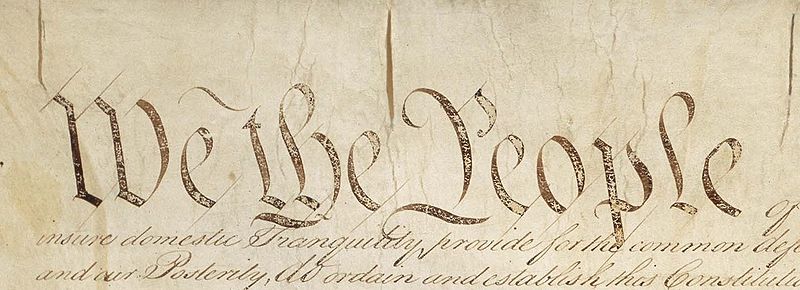
Today as a result, “We The People” have less ability to check the unconstitutional actions which are proposed and passed by the Federal
Government.
Either You Believe in Freedom and Equality or You Don’t!
Every question and issue in the domain of current events comes back to the basic question as to whether or not you believe in freedom or not and whether you believe in equality or not.
At the core of this question is whether or not you believe in the three unalienable rights found in the Declaration of Independence:
1. Life
2. Liberty
3. Pursuit of Happiness (Property)
As Frederic Bastiat in “The Law” says “In spite of the cunning of artful political leaders, these three gifts from God (referring to life, liberty and property) precede all human legislation, and are superior to it.
“Life, liberty, and property do not exist because men have made laws. On the contrary, it was the fact that life, liberty, and property existed beforehand that caused men to make laws in the first place.”